
SecureSpells
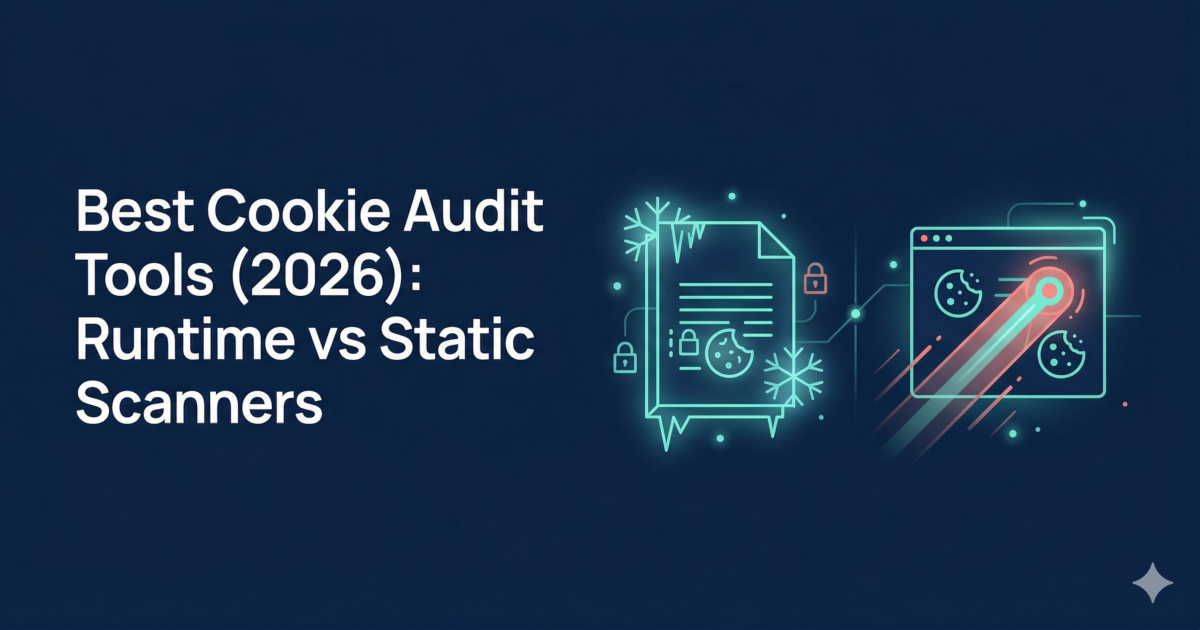
Best Cookie Audit Tools (2026): Runtime vs Static Scanners
Best Cookie Audit Tools (2026): Runtime vs Static Scanners
The best cookie audit tool is one that verifies real runtime behavior, not just a static cookie inventory. It should detect scripts and trackers firing before consent, map third-party requests, and prioritize remediation. Start with a runtime audit report, then validate fixes with re-scans after each tracking or CMP change.
Cookie audit tools help you verify whether your site collects, stores, or transmits cookies and tracking data in line with GDPR and ePrivacy requirements. This guide explains what they do, how to evaluate them, and why the distinction between runtime and static auditing matters. Scope: EU/EEA GDPR and ePrivacy Directive. UK GDPR applies equivalent principles.
This article is for educational purposes and does not constitute legal advice. For compliance decisions, consult a qualified legal or privacy professional.
- Cookie audit tool
A tool that checks your site for cookies and tracking scripts, with a focus on verifying compliance behavior: what fires before consent, what data leaves your domain, and whether your consent setup actually blocks non-essential tracking.
- Runtime audit
Testing that runs your site in a real browser and observes what actually fires — cookies, scripts, and network requests — including before consent is given. Only runtime audits detect pre-consent violations and hidden trackers.
- Static scan
Analysis that reads HTML, a cookie list, or a page snapshot. Fast and useful for inventory; misses trackers loaded dynamically, after page load, or only when certain user conditions are met.
What a cookie audit tool should verify
A reliable cookie audit tool checks more than a cookie list. At minimum, it should verify:
- Pre-consent firing — Does any non-essential cookie or tracker load before the user gives consent?
- Third-party requests — What domains receive data on a visit (e.g. analytics, ad networks, pixels)?
- CMP effectiveness — When a user rejects cookies, does tracking actually stop?
- Policy accuracy — Do the cookies found on the site match what the privacy/cookie policy discloses?
- Dynamic loading — Are trackers injected via JavaScript, tag managers, or lazy-loaded scripts?
If a tool only lists cookies found in the HTML and does not check any of the above, it will give false assurance.
Runtime audits vs static cookie scans
| Approach | What it checks | Key limitation |
|---|---|---|
| Runtime audit | Real browser session: what fires before and after consent, network requests, consent bypass detection | Requires a tool with browser-execution capability |
| Static scan | HTML source, cookie lists, page metadata | Misses dynamic scripts, post-load trackers, and CMP bypass scenarios |
| Combined | Cookie inventory + behavioral audit | Most thorough; use static for inventory, runtime for compliance verification |
For GDPR compliance, runtime auditing is the higher bar. Pre-consent firing and hidden consent bypasses are only visible when the site is executed like a real visitor and cookies are rejected. See Why runtime GDPR scanning detects real violations.
Tool comparison table and selection framework
When evaluating cookie audit tools in 2026, use this framework:
| Criteria | Why it matters |
|---|---|
| Runtime capability | Detects pre-consent firing and hidden trackers; static-only tools miss these |
| EU/GDPR-focused risk model | Checks aligned with consent requirements, ePrivacy, and EDPB guidance |
| Clear, actionable report | Findings you can act on: which URL, which script, what the risk is |
| Repeat/scheduled scans | Sites change after every release; one-time audits go stale |
| Third-party request mapping | Shows what domains receive data, not just which cookies are set |
| CMP interaction testing | Verifies that rejecting cookies actually stops tracking |
Avoid tools that only generate a cookie list without testing whether any of those cookies fire before consent.
Run a free cookie audit. See what actually loads before consent on your site.
Methodology and sources
- Comparison criteria based on EDPB Cookie Banner Taskforce guidance and ePrivacy Directive requirements.
- Last updated: 2026-03-26. Tool capabilities change; verify with vendors before purchase.
Related Articles