AI-generated (Gemini Pro)
GDPR Compliance Checklist 2026: 10 Critical Steps for Every Website
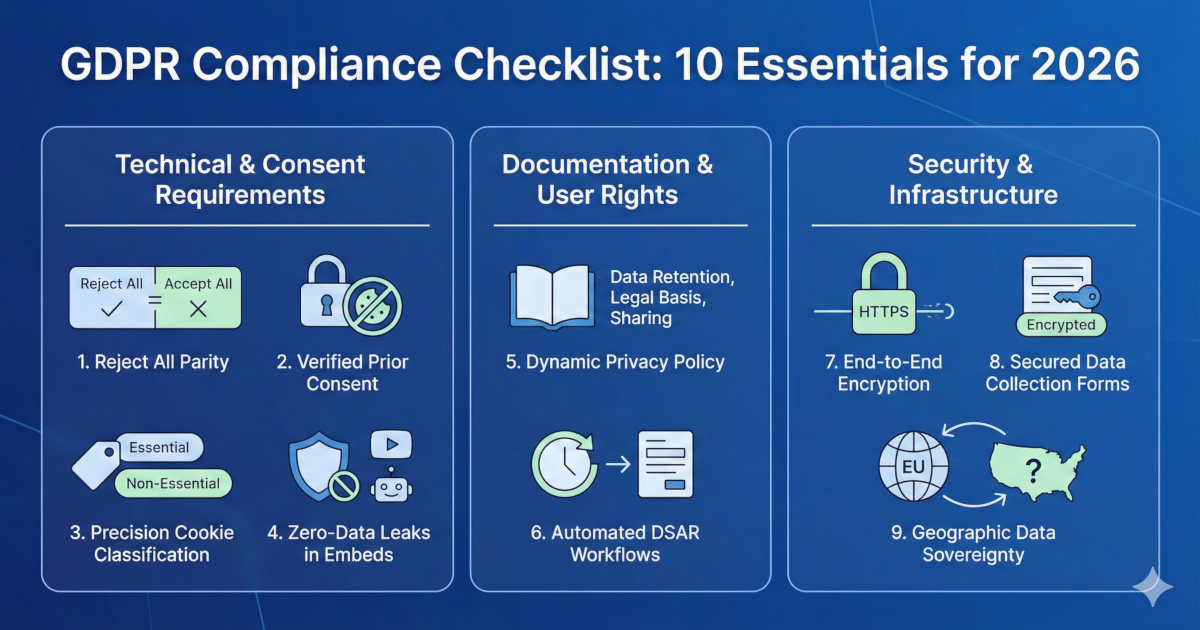
GDPR Compliance Checklist: 10 Essentials for 2026
A GDPR compliance checklist for websites must include: button parity on consent banners (equal prominence for "Reject All"), prior consent for non-essential cookies, accurate cookie classification (no mislabeling trackers as essential), zero data leaks in third-party embeds, dynamic privacy policies, DSAR workflows, HTTPS encryption, secured forms, geographic data sovereignty verification, and regular behavioral audits. These 10 steps ensure compliance with GDPR Articles 6, 7, and 32, plus ePrivacy Directive Article 5(3).
Regulatory enforcement has shifted. In 2025 and 2026, Data Protection Authorities (DPAs) have moved beyond Big Tech to audit Small and Medium Enterprises (SMEs). A single non-compliant form or a "leaky" cookie banner is now enough to trigger an investigation.
Based on thousands of SecureSpells behavioral scans, we have identified the top 10 areas where websites must focus to remain compliant.
Technical & Consent Requirements
1. Implement a "Reject All" Parity
Your cookie banner must make it just as easy to "Reject All" as it is to "Accept All." Hidden reject buttons or multi-step opt-outs are now strictly classified as Dark Patterns—see the EDPB Cookie Banner Taskforce report. Learn more: Cookie banner compliance guide.
2. Verified Prior Consent Logic
Non-essential cookies (analytics, marketing, personalization) must be programmatically blocked until the user provides affirmative consent (ePrivacy Art 5(3), GDPR Art 7). See: How to detect cookies loading before consent.
3. Precision Cookie Classification
Do not mislabel trackers as "Essential." Only scripts required for core functionality (security, load balancing, or shopping carts) bypass the consent requirement.
4. Zero-Data Leaks in Third-Party Embeds
Social media widgets, YouTube players, and chatbots often drop trackers automatically. Use "Click-to-Load" placeholders or consent-aware wrappers to ensure these scripts remain dormant until approved. Read more: How trackers bypass cookie consent.
Documentation & User Rights
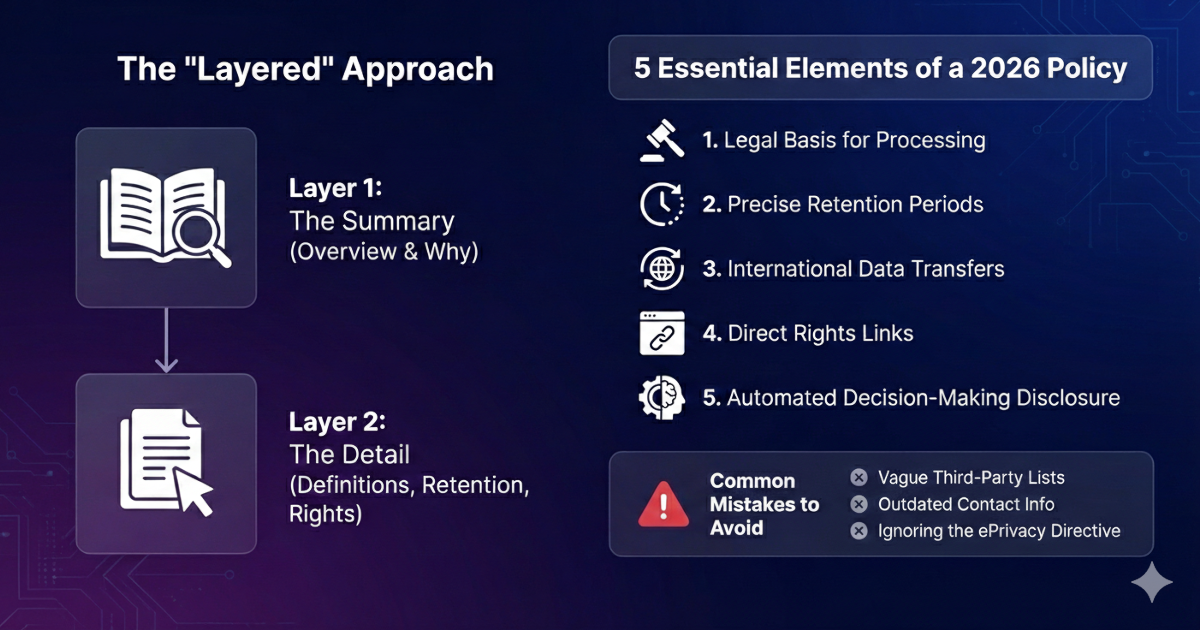
5. Dynamic Privacy Policy
Your policy must be more than a static document. It must clearly outline:
- Data Retention: How long you keep data.
- Legal Basis: (e.g., Consent, Legitimate Interest, or Contract under GDPR Article 6).
- Third-Party Sharing: A transparent list of who receives user data.
6. Automated DSAR Workflows
Users have a right to access, delete, or correct their data. Ensure your team has a clear process for handling Data Subject Access Requests (DSARs) within the one-month legal window (extendable in complex cases).
Security & Infrastructure
7. End-to-End Encryption (HTTPS)
SSL/TLS is no longer optional. Ensure all assets, including third-party iframes and images, are served over HTTPS to prevent "Mixed Content" security warnings and data interception (GDPR Article 32).
8. Secured Data Collection Forms
If you collect PII (Names, Emails, Phone numbers), your forms must be encrypted and include a clear link to the specific section of your privacy policy explaining that data usage.
9. Geographic Data Sovereignty (Schrems II)
Verify where your third-party tools store data. If data is transferred outside the EU (e.g., to the US), ensure you have Standard Contractual Clauses (SCCs) or equivalent frameworks in place.
Maintenance
10. Conduct Regular Behavioral Audits
Compliance is a moving target. Websites change, plugins update, and marketing teams add new tags. A regular GDPR website audit is the only way to catch "compliance drift" before a regulator does. See our full guide: How to audit your website for GDPR compliance.
Continuous Compliance Monitoring: Don't wait for a fine to find out your site is leaking data.
Why Compliance is a Competitive Advantage
In 2026, privacy is a trust signal. Websites that respect user choices see higher brand loyalty and lower long-term legal risk. For startups and SMEs, following this checklist isn't just about avoiding fines—it's about building a defensible, sustainable digital presence.
Is your team ready for a full audit? Explore our plans for deep-dive technical remediation steps and risk roadmaps for every item on this list.
Related Articles