Why Subscription Beats a One-Off GDPR Audit (2026)
Ott Ristikivi | Founder & CEO of SecureSpells
4 min read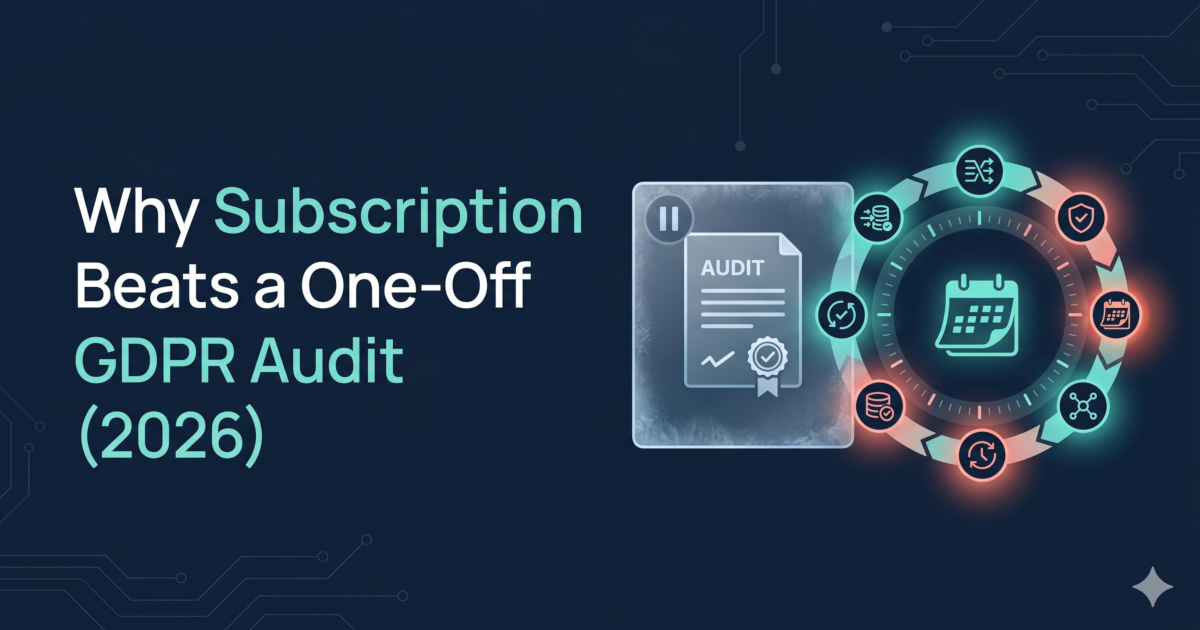
SecureSpells
Snapshot vs reality: why one audit is not enough
A one-off GDPR audit shows how your site behaved on the day of the scan. It does not protect you the day after a developer ships a new tag, your CMP vendor updates behaviour, or marketing adds a pixel. Subscription-style or scheduled runtime checks re-run the same consent-and-network proof on a cadence you control—so regressions surface before they sit in production for months. For EU/EEA GDPR and ePrivacy, what matters is ongoing alignment between policy, banner, and what actually executes.
Scope: EU/EEA GDPR and ePrivacy (cookies / tracking before consent). UK GDPR follows equivalent principles. This article is educational, not legal advice.
This article is for educational purposes and does not constitute legal advice. For compliance decisions, consult a qualified legal or privacy professional.
- One-off audit
A single compliance pass—manual or automated—at a fixed date. Useful for baselines, M&A, or pre-launch sign-off; it does not observe future changes.
- Recurring / subscription verification
Repeated runtime checks on a schedule (e.g. weekly or after releases). Aligns with how sites actually change: code, tags, consent strings, and third-party scripts.
- Runtime audit
Testing in a real browser to see what requests and cookies fire before and after consent—not only what appears in a static cookie list. Contrast with static-only approaches in runtime vs static scanning.
What changes after the “green” one-off report
Typical events that invalidate a months-old audit:
- Releases and hotfixes — New analytics, A/B tests, or chat widgets added without a full privacy review.
- Tag manager edits — Google Tag Manager (or similar) triggers change; a tag that was gated can fire early again.
- CMP configuration — Vendor updates, new categories, or template changes alter what blocks before consent.
- Third-party scripts — Partners swap endpoints or load additional sub-resources; behaviour drifts from the last scan.
A single snapshot cannot catch those unless you re-run the same runtime checks each time. That is the core argument for recurring verification, whether you buy it as a subscription product or run an internal cadence.
When a one-off audit is still the right move
One-off audits remain appropriate when:
- You need a baseline before launch or before a board / investor review.
- You run rare releases and can manually re-audit after each material change.
- You are proving a specific fix after an incident (then lock the change and document it).
If your release cadence is low and one person owns every tag change, you can sometimes substitute discipline for automation—but the burden is on process, not the audit date.
When subscription or scheduled checks pay off
Recurring runtime checks matter more when:
- Marketing ships often — Landing pages, campaigns, and experiments touch the public site weekly.
- Agencies manage client sites — Multiple properties and owners multiply the risk of silent regressions.
- You lack a dedicated privacy engineer — Scheduled checks act as a safety net when nobody owns “post-deploy consent verification.”
SecureSpells supports scheduled audits (recurring checks on domains you assign), not live end-user session monitoring: each run is an isolated browser test, aligned with how regulators reason about pre-consent behaviour.
How to choose: one-off, manual cadence, or product subscription
| Approach | Best for | Risk if over-relied on |
|---|---|---|
| One-off audit | Launch, acquisition, incident response | Stale picture after the next deploy |
| Manual re-checks (e.g. quarterly playbook) | Small teams with strict change control | Skipped under pressure; human error |
| Scheduled / subscription runtime audits | Active sites, agencies, frequent releases | Must still fix findings; tooling is not legal advice |
Pair any approach with the free cookie audit tool for an on-demand runtime pass when you ship something material.
Check your production URL after changes. See what fires before consent today—not last quarter.
Methodology and sources
- Product positioning for scheduled vs on-demand audits aligns with SecureSpells monitoring-slot model (isolated Playwright runs, not live user traffic). Verify current plans on pricing.
- Last updated: 2026-04-22.